June 28, 2026 | The Butterfly People
Jesus Christ: Yesterday, Today and Forever~
I saw a movie a couple of months ago called The Story of Everything. It is excellent and I highly recommend it. It succinctly lays out the origins of the universe—and life—using the empirical evidence we have discovered over the past five centuries, and especially in the past century. After watching the movie, no honest person can believe that the universe is eternal. Mathematics, the one science that atheists can still agree upon, clearly demonstrates that the universe had a beginning and it will have an end. Nor can anyone believe that life came about by random chance, the movie demonstrates how that is mathematically impossible too. By extension, evolution, beyond the “family” rank in the taxonomic ranking system, is mathematically impossible too.
Saint Thomas Aquinas describes five philosophical proofs for God’s existence (philosophy being a higher science than mathematics). And a cursory review of the internet yields even more proofs for God’s existence—and engagement—in our lives from theological proofs (the highest science).
Yet, for all the irrefutable empirical, philosophical, and theological evidence for God’s existence and engagement, there are still atheists, agnostics, and deists. Why?
Let’s define our terms. An atheist is someone who doesn’t believe in God’s existence. An agnostic is someone who doesn’t know if God exists or not. And a deist is someone who believes that a creator exists but then abandoned His creation—the watchmaker who walks away from the watch he made.
Why have I grouped agnostics and deists together with atheists? Because all three live as if God doesn’t exist, which is the ultimate proof of what one actually believes.
Back to my question: why is atheism, agnosticism, and deism so popular when it is mathematically, empirically, philosophically, and theologically impossible? Here are two short answers:
1. Being liked. Living like an atheist is the way to go if fitting in, not sticking out, being accepted, and being praised is important. Thus, the vast majority of Americans live like atheists do. Living like a true Christian means potentially losing out on being liked or even accepted.
2. Sacrifice is hard. If we accept the truth of God’s existence and the revelation of Jesus Christ, then we have to sacrifice something and sacrifice is hard. Hey, it’s a lot easier sleeping in on Sunday morning, or exercising, or mowing the lawn, etc., than getting ourselves together to attend Mass and serve God. The ruse that I don’t believe in God gets me out of making any kind of sacrifice. That ruse won’t keep you out of hell or a long painful purgatory—those are sacrifices too.
What follows is a beautiful story I stumbled across about children in Joplin Missouri who saw “butterfly people” (angels) during a devastating tornado that ripped through there in 2011. One final proof for God – personal experience. Enjoy.
May Almighty God Bless You,

Fr. Thomas Nathe
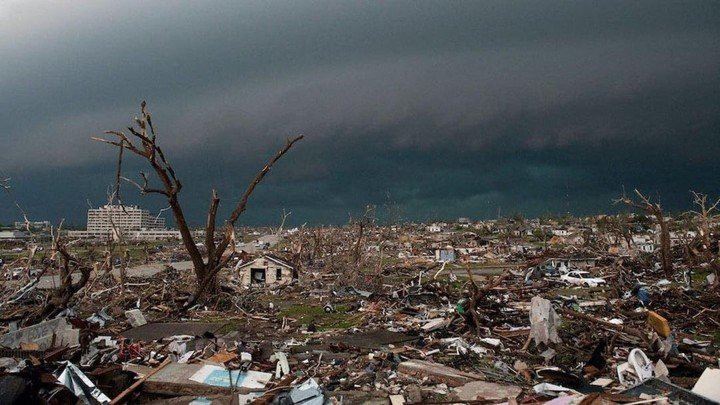
2011 Joplin, MO tornado devastation
Who Were The ‘Butterfly People’ Children Said They Saw During The 2011 Joplin Tornado?
https://allthatsinteresting.com/joplin-butterfly-people
By Stacy Fernandez | Edited By Eilish O'Sullivan
Published May 7, 2026
On the evening of May 22, 2011, an EF5 tornado (the highest on the scale used to estimate tornado intensity) carved a 22-mile path through Joplin, Missouri, killing 161 people, injuring more than 1,000, and destroying over 7,000 homes and buildings, according to the National Institute of Standards and Technology reports.
It remains one of the deadliest tornadoes in the United States since modern record-keeping began in 1950 and one of the costliest in American history, with losses approaching $3 billion.
In the weeks and months that followed, as the city began to process what happened, something unexpected started circulating. Children — dozens of them, from different parts of Joplin, who had no connection to one another — began telling their families the same story. During the storm, they said, they saw winged, glowing figures that hovered above them, shielding them from debris. Some called them angels; others just called them the “Butterfly People.”
A TikTok video by @addy0472 recently went viral claiming that the Butterfly People were actually victims whose skin had been ripped off their backs by the wind, creating wing-like flaps. But the creator later corrected themselves in the caption, saying that’s not what happened. The actual story is more complicated than that.
Children Across Joplin Described The Same Thing
The accounts started filtering through the Joplin Child Trauma Treatment Center, set up specifically to help children deal with what they had experienced, the St. Louis Post-Dispatch reported.
Therapists heard first-hand stories from children and young adults who described seeing white lights as well as visions of butterflies or butterfly-like beings that had helped keep them safe during the storm. These stories came from school children of all ages, rich and poor, regardless of their religious beliefs.
Two accounts in particular became widely shared. In each account, the basic premise was that while the tornado got closer to a parent and child, the parent tried to protect them. But afterward, the child told the parent that a butterfly person had really been the one protecting them. In both cases, the parent and child were unharmed.
An 11-year-old boy told his Sunday school class he had seen the Butterfly People the night of the storm. And a badly injured 14-year-old girl said that real butterflies had been visiting her throughout the summer as she healed.
What made the stories so striking was not just their content but their consistency. Counselors spoke to dozens of traumatized children across the town who didn’t know each other, and the descriptions matched. The figures were described as winged, luminous, and protective. Some children described the Butterfly People shielding them from debris. Others said they saw the figures carrying people up into the sky.
Adults reported similar experiences, too. One nurse treating the injured said she witnessed a tall, robed figure watching over a mother and child and realized it was something otherworldly.
Former newspaper reporter Marta Churchwell, a self-described skeptic who did not believe in angels, investigated the accounts and conducted her own interviews with survivors. After speaking with numerous people, she said she could not discount what they described since too many children who didn’t know each other had told the similar stories.
Joplin Butterfly Mural
A City Covered In Butterflies
Months after the tornado, Joplin moved forward with plans for a community mural. Artist Dave Loewenstein, who had been planning the project before the tornado struck, returned to the city and held a town meeting.
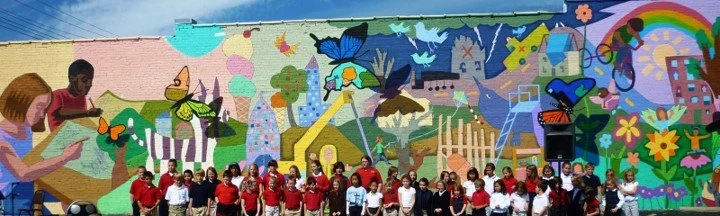
More than 200 volunteers showed up, most of them children, and Loewenstein asked them to submit pictures that would inspire the design. He had never mentioned the Butterfly People, but the children drew them.
The finished mural, titled “The Butterfly Effect: Dreams Take Flight,” was painted on the side of Dixie Printing and became one of the city’s most recognized symbols of recovery. Loewenstein said the butterfly imagery represented the rebirth of the city.
A documentary titled “The Butterfly People,” directed by local filmmaker Gregory Fish, later investigated the phenomenon through first-person survivor accounts. According to the Lawrence County Record, the film won Best Feature Film at the First City Film Festival. A book, “Butterflies at the Window: A Story of Butterfly People and Miracles in the Storm” by Sandi J. McReynolds, collected the interviews and accounts in full.
In 2014, Joplin opened the Butterfly Garden and Overlook, a healing garden and memorial that explicitly acknowledges the stories children told about butterflies protecting them during the tornado. Butterfly imagery, including murals, sculptures, T-shirts, and business signs, came to dominate the city’s visual landscape in the years after the tornado.
Were They Really Butterfly People?
There’s no way to get a definitive answer. The St. Louis Post-Dispatch, which published the original account of the phenomenon, hovered between belief and skepticism.
Maybe one child told a vivid story, and it spread. Perhaps the extreme stress of a near-death experience caused people to perceive protective figures, or Joplin’s predominantly Christian community shaped the way children described what they saw, reaching unknowingly for the imagery of angels and wings.
Or perhaps, as many in Joplin still believe, something was there.
What is not in dispute is that the Butterfly People, real or not, helped a devastated city find meaning in the aftermath of disaster.