May 31, 2026 | The Sacred Heart of Jesus, Part 2 of 3
Jesus Christ: Yesterday, Today, and Forever ~
The Sacred Heart of Jesus (Part Two of Three)
Last week I began a three-part series on the Sacred Heart of Jesus. In case you missed it, you can find the first part on the CRC website. What follows is the second installment of Archbishop Etienne’s letter on the Sacred Heart of Jesus. It is excellent and worthy of a focused and prayerful reading. You will gain much spiritual fruit if you do. You can find the whole document here https://archseattle.org/sacredheart/. Enjoy.
In the Sacred Heart of Jesus,

Fr. Thomas Nathe
A continuation — Part Two of Three — of
“Learn from Me for I Am Meek and Humble of Heart”
A Pastoral Letter on the Sacred Heart of Jesus
Archbishop Paul D. Etienne
The Heart of Jesus: Revelation, Not Metaphor
When Jesus speaks of his heart in the Gospel, he is not merely offering a poetic image or inviting sentiment. He is revealing the interior truth of his person. In those words, “I am meek and humble of heart” (Matthew 11:29), the Son of God opens to us the deepest center of his human and divine life.
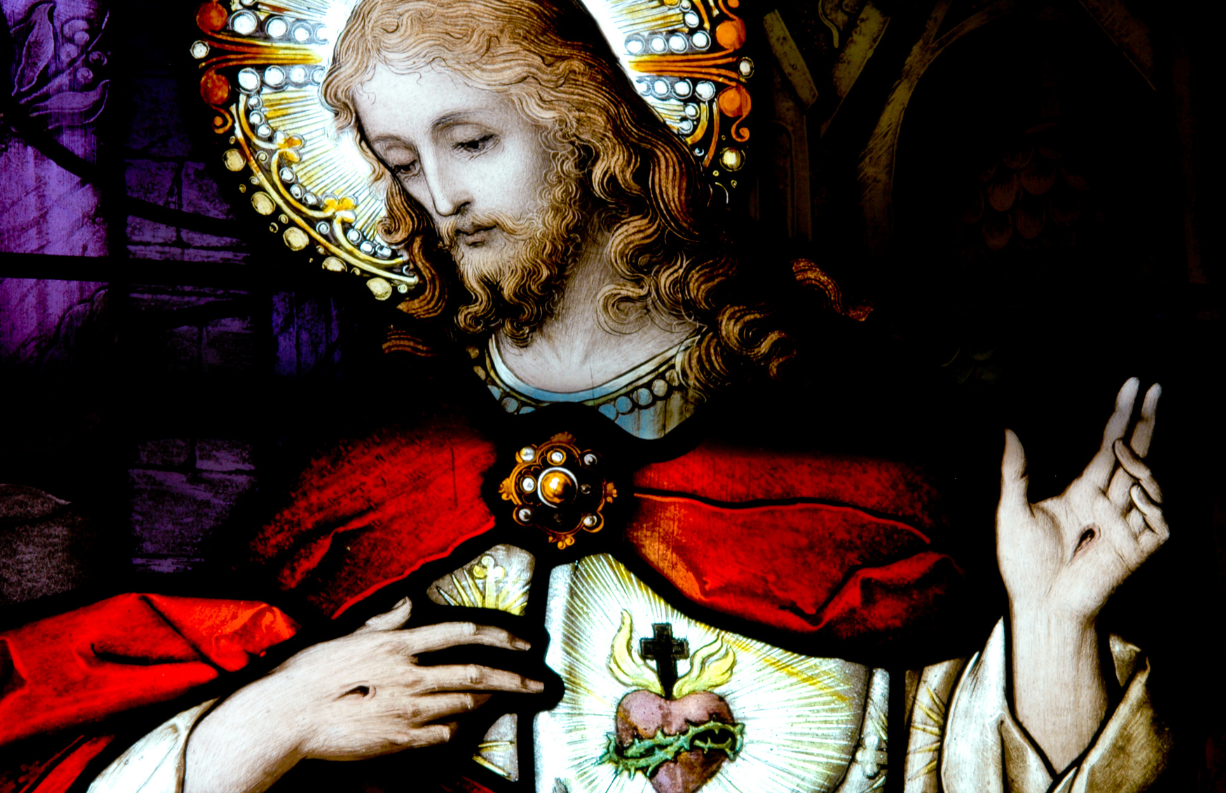
The Church’s devotion to the Sacred Heart arises precisely from these words of Christ. As the tradition — as documented by Jesuit Father John Croiset in the book “The Devotion to the Sacred Heart of Jesus” — makes clear, “The particular object of this devotion is the immense love of the Son of God, which induced Him to deliver Himself up to death for us and to give Himself entirely to us in the Blessed Sacrament of the altar.” The Heart of Jesus, therefore, is not an image to be contemplated, but a person to be known, a love to be received, and a mystery into which the Church is drawn.
When the Church speaks of the “heart” of Christ, we do not contemplate his heart separate from his body. As Pope Francis taught, “Devotion to the heart of Christ is not the veneration of a single organ apart from the Person of Jesus. What we contemplate and adore is the whole Jesus Christ, the Son of God made man, represented by an image that accentuates his heart.” When we speak of the heart of Christ, then, we are speaking of Christ’s immense love, which consumed his whole being. True devotion to the Sacred Heart is devotion to the love of the Incarnate Son, crucified and risen, who gives himself entirely for the life of the world.
The Heart of Christ and the Wounded Human Heart
In the Gospels, Jesus consistently identifies the human heart as the center of moral and spiritual life: “From within people, from their hearts, come evil thoughts…” (Mark 7:21; cf. Matthew 15:19). The disorder of the world; the divisions within families, communities and even within the Church — these are not just structural or political problems. They begin in the human heart.
Devotion to the Sacred Heart speaks directly to this reality. It does so without naiveté, recognizing that the obstacles to conversion are often interior: tepidity, self-love, pride, and passions left unchecked. The Sacred Heart is proposed not as a rebuke to our humanity, but as a remedy — the divine response to the wounded human heart.
In the revelation of the Sacred Heart, the Heart of Christ is revealed as full of love and mercy for us. From this heart flows the grace that alone can heal what sin has disfigured. In Christ, God does not merely call us to conversion; he gives a new heart.
I recall the words of Catholic writer Flannery O’Connor: “All human nature vigorously resists grace because grace changes us and the change is painful.” Christ came into the world precisely to give us this grace. Perhaps his love is what gives us the motivation to overcome this resistance and to receive and share the immense love of God: Heart speaks to heart.
Christ Dwelling in the Heart of the Believer
The New Testament deepens this mystery by proclaiming that the love revealed in the Heart of Jesus is not something external to us. St. Paul writes: “Christ lives in me” (Galatians 2:20) and “the love of God has been poured out into our hearts through the Holy Spirit” (Romans 5:5). Devotion to the Sacred Heart, rightly understood, is profoundly sacramental and ecclesial. It is ordered toward communion and unity: Christ dwelling in the heart of the believer and shaping the believer’s heart according to His own.
The purpose, then, of devotion to the Sacred Heart is not emotional consolation, but transformation. The ultimate goal of this devotion is that the heart of Jesus and the human heart become one. A mature Christian life is one lived in, with and for Christ — a life filled with, and motivated by, ardent love caught from Christ’s own loving heart. That love is what forms disciples, sustains fidelity and sends the Church on mission.
Reparation: Love Responding to Love
If devotion to the Sacred Heart begins in the revelation of Christ’s love, it leads toward reparation — not as a burden imposed upon the faithful, but as the proper response of love to love rejected. Reparation must not remain at the margins of Christian life, but at its very center, for it flows directly from communion with the crucified and risen Lord.
To speak of reparation is to acknowledge a sober truth: Love can be refused. St. John Fisher, the English bishop who was martyred in 1535, lamented that “we give no thought to his love, nor do we recognize the extent of his kindnesses to us … the remarkable mercy that he has continually shown to sinners does not move us to form our lives and conduct according to his most holy command.” Reparation is the Church’s refusal to remain indifferent where Christ’s love has been ignored, forgotten or despised.
Yet reparation is never an attempt to “add” to Christ’s saving work. Rather, it is the grace-filled participation of the baptized in his one sacrifice. As the tradition wisely counsels, “Unite the little which you do to the infinite amount which Jesus Christ accomplishes. Thus, while doing nothing yourself, you shall do much through Jesus Christ.” Reparation is not self-reliance; it is communion.
The Sacred Heart and Eucharistic Communion
The Heart of Jesus is revealed most fully where his love is most completely given: in the self-offering of the cross and in the permanent gift of the Eucharist. As the Church teaches, “The immense love of the Son of God … induced Him to deliver Himself up to death for us and to give Himself entirely to us in the Blessed Sacrament of the altar.”
Devotion to the Sacred Heart is inseparable from Eucharistic faith, for the Eucharist is the privileged place where the Church encounters the living Heart of Christ. In every celebration of the Mass, the same love that beat in the Heart of Jesus on Calvary is made present sacramentally and offered anew for the life of the world. Eucharistic communion, therefore, is not only reception; it is conformation — the shaping of our hearts according to his.
Devotion to the Sacred Heart finds its most authentic expression here. The Eucharist is the sacramental locus of this treasury, where Christ gives not something of himself, but himself entirely.
For this reason, frequent Communion, Eucharistic adoration, and the offering of daily life in union with the Mass are not just optional devotional practices; they are concrete ways in which the faithful learn to live from the Heart of Christ.
Such communion bears fruit in peace. Where hearts are formed by Eucharistic communion with the Sacred Heart, division gives way to reconciliation, indifference to charity and fear to hope. St. Paul exhorts the Church: “Let the peace of Christ control your hearts” (Colossians 3:15).
All of this calls for interior conversion. Without the right interior dispositions, devotion risks becoming merely performative or routine. But with them, our devotion can become transformative. In an age of distraction and spiritual fatigue, interior recollection is itself an act of reparation. To place the Heart of Jesus before one’s eyes — whether through Eucharistic adoration or through contemplation of a sacred image — is not escapism. It is an act of resistance to a culture that no longer knows how to dwell with love.
The Sacred Heart and the Mission of the Church
The love revealed in the Sacred Heart of Jesus is never self-referential. It is, by its very nature, missionary. The Heart that was opened on the Cross remains open in the life of the Church, sending her forth as a sacrament of Christ’s love for the world. True devotion to the Sacred Heart does not withdraw the believer from the world but configures the Church for her evangelical mission.
This missionary character flows directly from the inner logic of the Gospel. Jesus said: “Where your treasure is, there also will your heart be” (Matthew 6:21). When the Heart of Christ becomes the treasure of the Church, her mission takes on his form — marked by humility, mercy, patience, and self-giving love. Evangelization ceases to be strategy and becomes witness, born of communion.
The Church does not invent her mission; she participates in the mission of the Son of God, Jesus. St. Paul expresses this with radical clarity: “I live, no longer I, but Christ lives in me” (Galatians 2:20). The apostolic life is possible only because Christ first gives himself interiorly, dwelling in the hearts of believers through faith (cf. Ephesians 3:17). Devotion to the Sacred Heart keeps this truth before the Church.
The tradition insists that the Heart of Jesus is “the treasury of all supernatural gifts and of all graces.” Mission does not arise from human zeal alone, but from abiding in this treasury. The Church evangelizes effectively only to the extent that she draws from the inexhaustible love of Christ and allows that love to shape her words, her works and her witness. Mission without communion is merely activism.
This has concrete implications. Where the Sacred Heart is known and loved, families find unity, communities are reconciled and hardened hearts are softened — not by force, but by mercy. The tradition speaks of the fruit of devotion to the Sacred Heart, “to establish union and peace in the most divided families” and “to obtain victory over the strongest passions.” These are not private benefits; they are evangelical signs in a fractured world.
Most Reverend Archbishop Paul D. Etienne, D.D., S.T.L.
Archbishop of Seattle
Next week – Part Three of Three