May 3, 2026 : The Last Rites
Jesus Christ is Risen – Alleluia!
Jesus rose from the dead and ascended into heaven. We want that as well. Receiving the Last Rites before our death is one powerful way to ultimately reach heaven. Sadly, many Catholics don’t receive the Last Rites because those taking care of them in their dying days don’t reach out to a parish to have a priest come and administer the sacraments to them. Let’s talk.
What is a sacrament? “A sacrament is an efficacious sign of grace, instituted by Christ and entrusted to the Church, by which divine life is dispensed to us through the work of the Holy Spirit. The sacraments are seven in number: Baptism, Confirmation, Eucharist, Penance (Confession or Reconciliation), Anointing of the Sick (Extreme Unction), Holy Orders, and Matrimony” (Glossary of the Catechism of the Catholic Church (CCC)).
The Last Rites refers to a Catholic who is in danger of death being visited by a priest and prepared spiritually and sacramentally for death. Only a bishop or priest may validly administer the Last Rites. The Last Rites always involves the Anointing of the Sick and usually the absolution of sins. If the person in danger of death is still lucid, they may also have their Confession heard and receive Viaticum (distribution of the Blessed Sacrament by a priest for those in danger of death). Hence, the Last Rites can include up to three different sacraments: Anointing of the Sick, Confession, and Viaticum. I’ll unpack all three in a moment.
When should someone ask for the Last Rites? When someone is in danger of death due to illness, injury, or old age, they may receive the Last Rites. Often though, a priest isn’t contacted until the failing person is on the point of death. This is unfortunate because many people at the point of death can no longer give their last Confession or receive Viaticum. In some cases, a priest isn’t contacted in time, and the person passes away before the priest could reach them. So please contact a priest as soon as a Catholic is in danger of death, before death is imminent.
Who can receive it? Catholics: practicing or not (lapsed); lucid or not; individually or in a group; anywhere the need arises.
How many times can a person receive the Last Rites? If a sick or injured person receives the Last Rites and recovers their health, they can, in the case of another grave illness or injury, receive the Last Rites again. If during the same illness or injury, the person’s condition becomes more serious, the rites may be repeated. For example, if someone in danger of death receives the Last Rites but weeks pass while the person remains in the same state, they may receive the Last Rites again.
The first of the three sacraments that constitute the Last Rites is that of Confession, or, more specifically, absolution from sins. If the person receiving the Last Rites is cognizant and able, the priest should hear their sacramental Confession. In most cases it will be their last. What a gift. Imagine being able to tell God all your unconfessed sins, expressing sorrow for them, and being absolved of them—just before dying! In cases where the person is no longer able to confess their sins, the priest assumes that if they could, they would, and proceeds to absolve them of their sins. Under either scenario, the person receiving absolution presumably will die in a state of grace. The absolution given during the Last Rites on both a person who has confessed their sins and one who wasn’t able to, contains something called the Apostolic Pardon. The Apostolic Pardon is an ancient prayer that in most cases prevents the deceased from going to Hell. Those who receive it will, in all likelihood, still go to Purgatory where they will work out God’s perfect justice for their sins, but eventually enter the Beatific Vision of heaven. You want to receive the Apostolic Pardon, it’s the ultimate “get out of jail free” card.
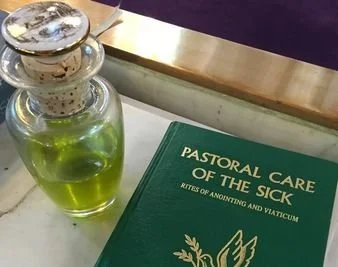
The next sacrament is the Anointing of the Sick. “Also known as the sacrament of the dying, administered by a priest to a baptized (Catholic) Christian who begins to be in danger of death because of illness, injury, or old age, through prayer and the anointing of the body with the oil of the sick. The proper effects of the sacrament include a special grace of healing and comfort to the Christian who is suffering the infirmities of serious illness or old age, and the forgiving of the person’s sins (Glossary CCC). It is also fitting to receive the Anointing of the Sick just prior to a serious operation. The same holds for the elderly whose frailty becomes more pronounced” (CCC 1515).
A person does not have to be lucid or even awake to receive the sacrament of Anointing.
Some assume that this sacrament is for the healing of the sick, injured, or dying, yet properly understood, its true purpose has more to do with uniting one’s suffering with Christ. Put another way, the sacrament of the Anointing of the Sick imparts the grace to carry the cross of the suffering—not remove it. Of course, God can do anything good, and if He wishes to heal, then all praise be to God. However, people who hope for healing from this sacrament, let alone expect it, will more than likely be let down.
The final sacrament that is administered is called Viaticum. Viaticum is the reception of the Blessed Sacrament in a state of grace before death. Remember, the dying person has just received absolution for their sins, putting them in a state of grace.
Viaticum is the Holy Eucharist received by those who are about to leave this earthly life and are preparing for the journey to eternal life. Communion in the body and blood of Christ who died and rose from the dead, received at the moment of passing from this world to the Father, is the seed of eternal life and the power of the resurrection.
The word is derived from an ancient Mediterranean tradition of a meal shared by those setting out on a journey. The Catholic Encyclopedia explains the rich history of this word as such: “Among the ancient Greeks the custom prevailed of giving a supper to those setting out on a journey. The provision of all things necessary for such a journey, viz. food, money, clothes, utensils and expense, was called ephodion. The adjectival equivalent in Latin of both this word is viaticus, i.e., “of or pertaining to a road or journey.” For this reason, “viaticum” is often referred to as “food for the journey,” in reference to the spiritual food of the Eucharist and the journey into Everlasting Life.
Contact the Parish
Often, a Catholic who is critically ill or seriously injured and should receive the Last Rites, but they don’t because no one thinks to call the parish. Usually, the person in need of this sacrament isn’t able to make the call themselves. For this reason, it is very important to talk to your spouse, adult children, or siblings about your desire to receive these rites when the need arises, as well as funeral arrangements. Don’t assume the people taking care of you in your dying days will know what you would want for yourself. Often, those who will take care of us when we are dying are not Catholic or are no longer practicing the faith and don’t know about the Last Rites. It is our responsibility to inform those who will be taking care of us when we die, about their need to call the local parish and to ask for the Last Rites. If you know of a Catholic who is in danger of death, ask them or someone taking care of them if they would like to receive the Last Rites. They can be fallen away Catholics. If they are agreeable to a visit from a priest, it might be the difference between salvation, and you know what.
Bear in mind that visiting the sick and praying for the living and the dead are Works of Mercy. We all have a responsibility before God to do these things, not just priests. Speaking of priests and the Last Rites. There are so few of us and so many of you that it can be hard to get hold of one of us in a pinch. So, please be proactive in reaching out to a priest as soon as a person is in danger of death. Numerous times calls from our answering service have gone unanswered because a priest wasn’t available.
A final note: if you are calling any of our locations after hours on behalf of someone in danger of death you can dial 9 and you will be redirected to our answering service which will inform of a priest of your need at any hour.
Yours in Jesus, the Divine Physician,

Fr. Thomas Nathe